
Showing posts with label Space. Show all posts
Showing posts with label Space. Show all posts
Failed stars and super-Jupiters
The brown dwarf is seen as a stellar failure, a dropout from the school of star formation. These gigantic objects with their puffy gaseous outer layers, are the universe's students that didn't quite make the grade. You see, in brown dwarfs, nuclear fusion - the process that gives stars their power - has given up the ghost, leaving them relatively cold and some no hotter than the human body. Neither planet nor star, brown dwarfs fall into the grey area between the most massive gas giant planets like Jupiter (which is why they're known as 'super Jupiters' because of their massive, gaseous nature) and the smallest stars. Their existence blurs the lines between what is a planet and what is a star and forces us to question the differences between how planets and stars form.

Stars form when clouds of molecular gas collapse under gravity and condense until the pressure and temperature at the centre of the collapsing cloud is so great, that nuclear fusion reactions - which turn nuclei of the element hydrogen into the heavier helium nuclei - ignite. This kind of top-down formation is one of the key differences between how stars and planets form. Meanwhile, the worlds of our Solar System and many others that astronomers have been studying over the past 20 years form through a bottom-up process, where a core gradually builds up, becoming bigger and bigger For the most massive planets, the core has enough gravity to begin stealing gas from the proto-stellar nebula around it, and this is where gas giants such as Jupiter and Saturn got their hefty atmospheres.
Hidden universe
If we just relied on our eyes, we'd find that we would be blind to most of what the universe has to offer. There would be so much that we would completely miss, from the explosive nature of gamma-ray bursts, to the dusty skeletons of galaxies and even the radiation left behind by the Big Bang. This is because the universe emits light that goes well and truly beyond what our eyes alone can see. Visible light, which is the light that we see making up our everyday surroundings, is just one small part of the electromagnetic spectrum. This runs all the way from low-energy radio waves through to astonishingly high-energy gamma rays. To us, anything that's regarded as outside of the visible part of the spectrum, we just can't see. You might be surprised to learn that we produce this hidden light on Earth too. Think of infrared night vision goggles, the X-rays you might get to see a broken arm with, ultraviolet security tags or radio waves transmitting music and telephone calls across the planet. In space, these other wavelengths of light are everywhere, coming from all kinds of cosmic objects. It's like a hidden universe, but luckily for us, astronomers are able to tune in to these other wavelengths to make the invisible visible.

Light is a funny thing, it is able to act like both a wave and a particle at the same time. This is why we say that a photon of light can have a wavelength. The longest wavelengths are radio waves, which range from a millimetre in length to many kilometres.

Star quakes
What does a star sound like? It might seem like a strange questioa but every star in the sky is generating sound waves, even if we can't hear them across light years of vacuum. What's more, these stellar waves have frequencies much too low for human hearing - periods of minutes to hours, compared to the 20 to 20,000 cycles per second our ears can pick up.

In effect, these sound waves are the same as the seismic waves that are known to cause earthquakes on our own planet Most earthquakes are triggered in Earth's relatively thin outer oust In a similar fashion, stellar seismic waves are generated by the churning of huge masses of gas in the upper layers, close to a star's visible surface. Both types of wave ripple out in all directions, passing all the way through either planet or star. These similarities mean that just as geologists can use seismic waves to probe Earth's inner structure, astronomers are now finding that sound waves can reveal the inner secrets of the stars.

Supernovas
Stars are large and volatile masses of energy, finely balanced to allow their existence to continue while also emitting large .amounts of energy into their surroundings. Their very presence is one of the wonders of the universe, with these giant hot and dense balls of gas able to survive the harsh reality of space. But when the finely-tuned balance of gravity and pressure within a star is altered, something rather remarkable often happens. Try to imagine an explosion more powerful than a billion suns, and you might start to understand how stars can meet their explosive end when they go supernova.

In 185 AD, Chinese astronomers were astounded when a new star appeared in trfe night sky for 1 eight months. The star appeared from nowhere and was stationary, ruling out the possibility of it being a comet. Although unknown at the time, those Chinese astronomers (and possibly Roman astronomers around the same period as well) unwittingly became the first people to record a supernova, which we know today as SN 185. In 2006, NASA's Chandra and XMM-Newton X-ray observatories imaged a remnant called RCW 86, a vast shell of gas seerningry ejected by SN 185. It might have taken 2,000 years, but we're gradually becoming able to observe and understand these massive events like never before.

In 185 AD, Chinese astronomers were astounded when a new star appeared in trfe night sky for 1 eight months. The star appeared from nowhere and was stationary, ruling out the possibility of it being a comet. Although unknown at the time, those Chinese astronomers (and possibly Roman astronomers around the same period as well) unwittingly became the first people to record a supernova, which we know today as SN 185. In 2006, NASA's Chandra and XMM-Newton X-ray observatories imaged a remnant called RCW 86, a vast shell of gas seerningry ejected by SN 185. It might have taken 2,000 years, but we're gradually becoming able to observe and understand these massive events like never before.
What are asteroids made of?
Protecting Earth is one of the main reasons why scientists keep a close eye on asteroids, which are space rocks of all shapes and sizes that can be found scattered throughout the Solar System.

It's unclear how meteoroids, the rocks that become meteors when they crash into Earth's atmosphere, were generated from asteroids. Still, NASA isn't ruling a link out and is examining asteroids to learn more about how the Solar System was formed.

How planets form
In a sense, planetary birth is a side effect of a larger birth: the formation of a star. Stars form from nebulas, massive clouds of gas and dust dominated by hydrogen and helium. Now and then, a disturbance in a nebula concentrates an area of gas and dust into a denser knot of material If the knot is big enough and dense enough, it will exert enough gravitational pull to collapse in on itself. The huge volume of super-dense gas concentrates at the knot's centre, and the gravitational energy heats it up to form a protostar. With sufficient mass, the energy of the protostar increases, eventually initiating a nuclear fusion reaction and graduating to a proper star.

Meanwhile, according to the solar nebula theory, surrounding gas and dust form a protoplanetary disc, or proplyd, around the protostar. When the protostar first begins to form, the surrounding material is still an unordered, slowly churning cloud. But the protostar's growing gravitational pull accelerates the cloud's movement, causing it to swirl around the centre.

Winds at twice the speed of sound
We've all got stuck out in or witnessed very strong winds here on Earth, from gusts that turn your umbrella inside out to tornadoes that rip up everything in their path. You might think these winds are a force to be reckoned with, but unless you've had a day floating around the gaseous atmosphere of ice giant Neptune you haven't seen anything yet!

You might think that Neptune's distance from the Sun. which creates temperatures as low as -218 degrees Celsius (-360 degrees Fahrenheit), would mean a world frozen solid by the subzero climate with not much going on in terms of weather. However, you would be incorrect. The winds that race through its hydrogen, helium and ammonia-laden atmosphere can reach maximum speeds of around 2,400 kilometres per hour (1.500 miles per hour), making this dark horse probably the most violently stormy world in the Solar System, and making our most powerful winds look like light breezes.

You might think that Neptune's distance from the Sun. which creates temperatures as low as -218 degrees Celsius (-360 degrees Fahrenheit), would mean a world frozen solid by the subzero climate with not much going on in terms of weather. However, you would be incorrect. The winds that race through its hydrogen, helium and ammonia-laden atmosphere can reach maximum speeds of around 2,400 kilometres per hour (1.500 miles per hour), making this dark horse probably the most violently stormy world in the Solar System, and making our most powerful winds look like light breezes.
Hurricanes bieeer than Earth
Easily one of the most famous storms in the Solar System, Jupiter's Great Red Spot is so large that it is visible through many Earth-based telescopes.

The Great Red Spot is thought to have been in existence for at least 340 years. The oval red eye rotates in an anticlockwise direction due to the crushing high pressure on the planet. Winds can reach over 400 kilometres per hour (250 miles per hour) around the spot, however, inside the storm they seem to be nearly nonexistent. And that's not all, this complicated weather system has an average temperature of about -162 degrees Celsius (-260 degrees Fahrenheit).

Dust storms that cover the planet
Now this is really bad weather - a dust storm that doesn't just cover an area, or even a hemisphere, but the entire planet. During summer in the Red Planet's southern hemisphere, when Mars is at its closest point to the Sun, solar heating can drive immense storms that blow up red dust and can obscure the surface for months. In 1971, when Mariner 9 arrived at Mars, it found the whole planet hidden under a veil of dust with only the volcano Olympus Mons visible. More recently, the Mars Exploration Rovers Spirit and Opportunity would struggle to survive in dust storms as the Sun's light was blocked and their solar panels covered by a coating of dust.

On Earth, moisture arms swirling storms, but on Mars there is only dust. Normally most of the dust is on the ground, but some is found in the atmosphere, where it scatters sunlight and makes the sky appear pinky-red.

Our angry stormy sun
We know our Sun as a brilliantly bright sphere that rises in the east and sets in the west each day. That's a simple way to describe it; what really goes on on its surface is far from the impression that it gives as it hangs, almost calmly, in the daytime sky.

While going anywhere near the Sun would be suicide with the searing heat and penetrating radiation combining to fry you alive in your spacesuit technology has revealed this star to be an angry, bubbling cauldron of solar activity.

Alien volcanoes on Io
In 1979, NASA's two Voyager spacecraft flew by Io, the fourth largest moon in the Solar System and the innermost of Jupiter's four main Galilean moons, and returned some startling information. While moons in the Solar System were once thought to be lifeless hunks of space rock, both spacecraft had directly observed volcanic features on Io. Bearing more resemblance to a pepperoni pizza than a giant moon, it was apparent that Io was one of the most fascinating and significant objects in our Solar System.

Our own Moon is one that appears to have been active in the past but has quietened down to become almost entirely dormant, retaining little to none of the volcanic activity that once sculpted its surface. Indeed only a few planets. Earth included, have changeable environments at all, making the discovery of Io all the more exciting Where once our Solar System was regarded as an ever-present museum of the past, moons such as this one have proven that it is still a lively and effervescent place. So what is it that makes Io so amazing?

Our own Moon is one that appears to have been active in the past but has quietened down to become almost entirely dormant, retaining little to none of the volcanic activity that once sculpted its surface. Indeed only a few planets. Earth included, have changeable environments at all, making the discovery of Io all the more exciting Where once our Solar System was regarded as an ever-present museum of the past, moons such as this one have proven that it is still a lively and effervescent place. So what is it that makes Io so amazing?
Pluto: our last frontier
It has been on a breathtaking journey 4.8 billion kilometres (3 billion miles) long. It has taken nine- and-a-half years. And it has cost $700 million (£460 million). But for patient astronomers working on the New Horizons mission, the spacecraft which is about to make the first-ever reconnaissance of Pluto is more than worth its half-ton weight in gold.

Launched on 19 January 2006. New Horizons is set to spend this summer flying by Pluto and its five known moons. It is already the closest man-made object to Pluto, but very soon it will be within a space whisker and scientists are very excited about the possible discoveries it will enable them to make.

Comets, asteroids and meteor showers
Every 133 years a comet that goes by the name of Swift-Tuttle makes its return to the inner Solar System. It last made an appearance 15 years ago. Each time it nears the Sun this speeding ball of ice, rock and dust grows a tail that deposits a glittering trail in its wake, replenishing it on each visit.

Every year, our very own planet moves through this cloud, causing those dust particles to come crashing through the atmosphere. Most of them are tiny just centimetres or even millimetres across, but as they burn up 100 kilometres (60 miles) above our heads they leave a bright streak of light. We call this a meteor, although you may know them by their more common name of shooting star. The space between the planets and around Earth's orbit is full of dust, so every night there will be one or two random meteors. But when the Earth travels through the cloudy trail of dust left by a comet such as Swift-Tuttle, there are so many meteors that it is described as a meteor shower. If you have ever seen one. then you'll know that meteor showers are among the most spectacular sights in the entire night sky.

Every year, our very own planet moves through this cloud, causing those dust particles to come crashing through the atmosphere. Most of them are tiny just centimetres or even millimetres across, but as they burn up 100 kilometres (60 miles) above our heads they leave a bright streak of light. We call this a meteor, although you may know them by their more common name of shooting star. The space between the planets and around Earth's orbit is full of dust, so every night there will be one or two random meteors. But when the Earth travels through the cloudy trail of dust left by a comet such as Swift-Tuttle, there are so many meteors that it is described as a meteor shower. If you have ever seen one. then you'll know that meteor showers are among the most spectacular sights in the entire night sky.
Observing the Sun
Observations of the Sun have been used for both scientific and religious observations for millennia. Civilisations have used the Sun to keep an accurate count of days, months and years since at least 300BC. while scientists such as Galileo studied the Sun through telescopes to discern some of its characteristics.

At the Chankillo archaeological site in Peru can be found the oldest solar observatory in the Americas, a group of 2.300-year-old structures used to track the motion of the Sun known as the Thirteen Towers. These towers provide a rudimentary solar calendar through which the Sun can be traced.
The solar cycle
Our Sun may be a great distance away but its fluctuations and perturbations are still felt here on Earth.

Every 11 years the Sun moves from a period of low activity, known as a solar niinimum, to a period of high activity, known as a solar maximum, and back again. When it is at its most active the Sun is even more violent than usual with a greater number of sunspots appearing on its surface and therefore more solar flares emitted into space. During its minimum point it is still a raging inferno firing material into space but, by romparison, it is much quieter and sunspots, and therefore solar storms, are rare.

Solar storms
Like the Earth, the Sun has an atmosphere, but the two are very different. The Sun's can be incredibly volatile with powerful magnetic activity that causes phenomena referred to as solar storms here on Earth.

Solar storms are violent outbursts of activity on the Sun that interfere with the Earth's magnetic field and inundate our planet with particles. They are the result of outpourings of energy from the Sun. either in the form of a Coronal Mass Ejection (CME) or a solar flare. The former is a release of a large amount of material, mostly plasma, from the Sun while the latter is a sudden release of electromagnetic radiation commonly associated with a sunspot. While no direct connection has been found between CMEs and solar flares, both are responsible for causing solar storms on Earth. The reason why these two events occur is due to the Sun's atmosphere and its turbulent interior, with all of its components playing a part in bathing our planet in bursts of energy.

All about the Sun
At about 150 million kilometres (93 million miles) from Earth lies a giant incandescent ball of gas weighing in at almost 2,000 trillion trillion kilograms and emitting power equivalent to 1 million times the annual power consumption of the United States in a single second. Since the dawn of Earth 4.6 billion years ago it has been the one ever-present object in the sky, basking our world and those around us in energy and light and providing the means through which environments, and ultimately life, can flourish. We see it every day and rely on its energy to keep our planet ticking, but what exactly is this giant nuclear reactor at the centre of the Solar System that we call the Sun?

Over 5 billion years ago a vast cloud of dust and gas was located where our Solar System is now. Inside this nebula something huge was happening; gravity was pulling together the debris, likely the remnants of another star going supernova, into one central mass. As the various metals and elements were brought together they began to fuse into an object at the heart of this nebula. This dense clump of matter, called a protostar, grew and grew in size until it reached a critical temperature due to friction, about 1 million degrees Celsius (1.8 million degrees Fahrenheit). At this point nuclear fusion kicked in and our Sun was born.

Where is our galaxy?
At the inner limit of the spiral arms, the bar and hub are surrounded by a structure known as the 5-kiloparsec Ring (one kiloparsec is around 3,260 light years). Although we cannot see it in visible light, the ring seems to contain huge concentrations of star-forming nebulas and young stars: it's probably the main generator of new stars in the Milky Way.

Above and below the main disc lies a relatively empty region known as the halo. Many faint, long-lived stars pass through this region on tilted orbits, but the halo's most obvious occupants are globular clusters - dense balls containing many tens of thousands of old, red and yellow stars that are generally found above and below the galactic hub. Similar red and yellow stars dominate the hub and bar - they are relatively poor in heavy elements, which allows them to shine for billions of years without evolving significantly. As a result, they are known as "Population II stars, in contrast to the younger, faster-evolving and heavy-element-enriched Population II stars in the galactic disc.

Journey through the Milky way
Look up at the sky on a dark, clear night and you cant miss the Milky Way - a broad swathe of pale light winding its way around the sky among many of the brightest individual stars. Ancient astronomers saw it as a stream of milk spilt across the sky by the goddess Hera when she suckled the hero Hercules, but today we know the Milky Way is something very different - an enormous disc of stars some 100,000 light years across, containing (at the latest estimate) around 200 billion individual stars.

Unsurprisingly, then, our Solar System is an insignificant speck within the overall scale of the Milky Way - all the planets and other large bodies orbiting the Sun are confined to a region just a few light hours across. In our part of the galaxy, stars are spaced far enough apart that even our nearest stellar neighbours appear as mere specks of right The closest of all, the triple star Alpha Centauri, is still around 4.3 light years away.

Unsurprisingly, then, our Solar System is an insignificant speck within the overall scale of the Milky Way - all the planets and other large bodies orbiting the Sun are confined to a region just a few light hours across. In our part of the galaxy, stars are spaced far enough apart that even our nearest stellar neighbours appear as mere specks of right The closest of all, the triple star Alpha Centauri, is still around 4.3 light years away.
Discovering new Earths
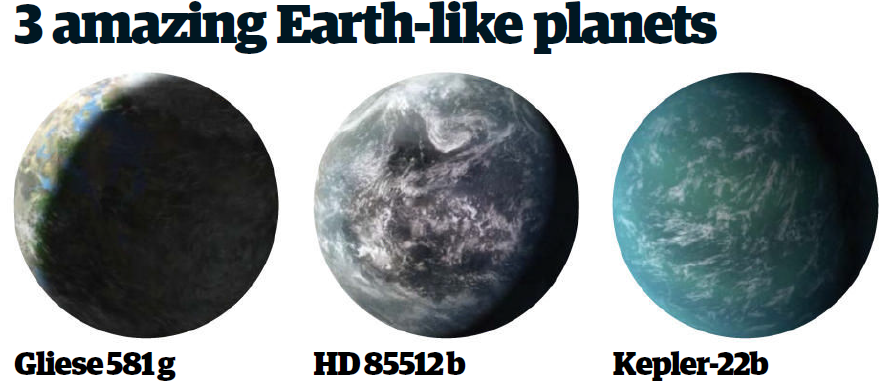
Planet hunting is a new and exciting area of astronomy barely two decades old that, thanks to missions such as NASA's Kepler telescope, is revealing more and more data about intriguing new worlds outside of our Solar System, known as extrasolar planets or exoplanets. Only in the last 20 years has sufficient technology been available to allow us to categorically prove the existence of these planets. While we're still some way off seeing detailed imagery of direct exoplanet observations, projects like NASA's James Webb Space Telescope and the European Extremely Large Telescope (E-ELT) will bring Earth-size exoplanets into view and even study the composition of their atmospheres.

The number of bizarre and familiar new worlds just waiting to be discovered is staggering, if estimates prove to be accurate. In our Milky Way alone there could be hundreds of billions of planets, and so far we've found just a few thousand. The ultimate goal for planet hunting is to find an Earth-analogous planet that could help ascertain whether life could potentially grab a foothold outside of our Solar System.
The number of bizarre and familiar new worlds just waiting to be discovered is staggering, if estimates prove to be accurate. In our Milky Way alone there could be hundreds of billions of planets, and so far we've found just a few thousand. The ultimate goal for planet hunting is to find an Earth-analogous planet that could help ascertain whether life could potentially grab a foothold outside of our Solar System.
Subscribe to:
Posts (Atom)